Home › Concrete Slab Installation
Superior Concrete Little Rock pours precise, level concrete slab foundations for a variety of residential projects in Little Rock, AR. From house slab foundations to shed slab and garage slab installations, we engineer each concrete slab to support the intended load and resist cracking. Our team manages site prep, forms, reinforcement, and finishing for reliable long term performance.
Superior Concrete Little Rock provides professional concrete slab throughout Little Rock, AR, Arkansas and the surrounding area. Our licensed, insured crew delivers safe, clean, on-time work with a free estimate before anything begins. Call (501) 251-1869 or request your free quote.
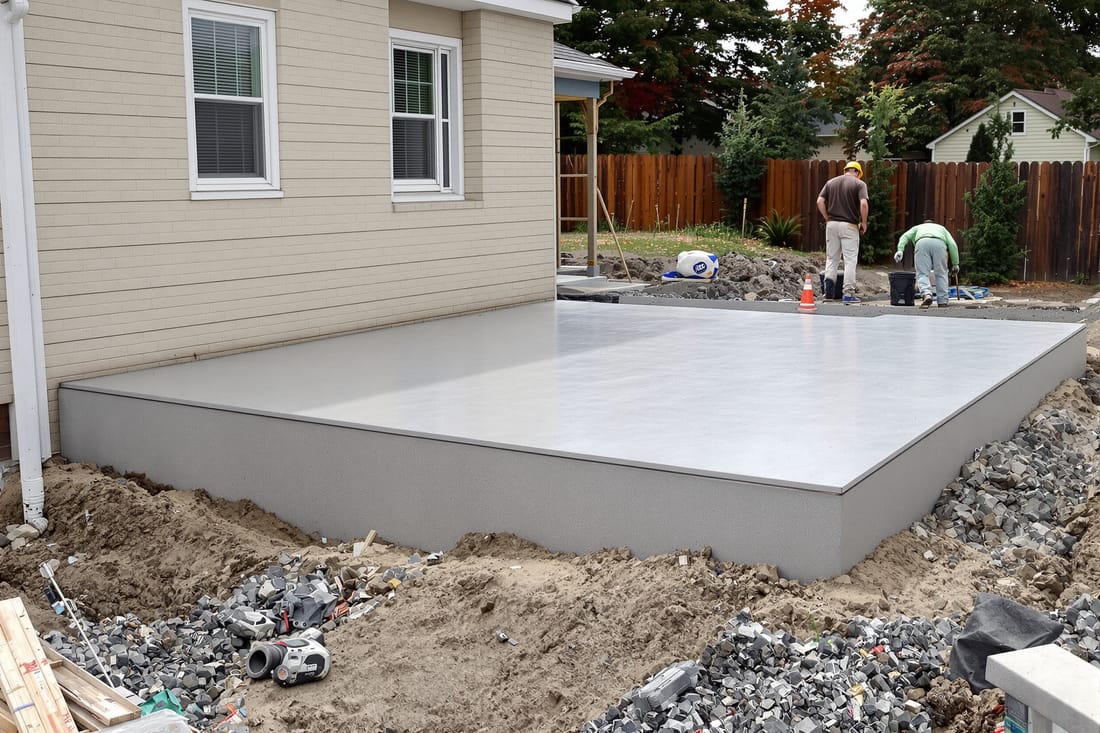
Concrete slabs built for Little Rock soil, weather, and use
When you hire Superior Concrete Little Rock for a concrete slab, you are not getting a one‑size‑fits‑all pour. We look first at how the slab will be used, the condition of your soil, and what the Arkansas weather will do to it over time. A patio slab that will see foot traffic and outdoor furniture is designed differently from a garage slab that has to hold vehicles or a shop slab that supports heavy equipment.
In Little Rock, clay soil that swells when wet and shrinks when dry is a big factor. If you pour a concrete slab on poorly prepared clay, it will usually crack and settle. We start with a site visit, check for soft or spongy areas, drainage patterns after a rain, and any existing slabs or structures nearby. Then we talk through thickness, reinforcement, and control joints in plain language so you understand what you are getting, not just a square footage price.
We time the work around local weather as much as possible. Spring and fall are usually best for concrete slab installation here because temperatures are moderate and we can control curing more easily. In July and August, we take extra measures like using set‑control admixtures, adjusting pour times to early morning, and more aggressive curing to protect the slab from rapid drying and surface cracking. That planning upfront is what helps your slab stay solid years down the road.
Step‑by‑step: how we install your concrete slab
Every concrete slab project with Superior Concrete Little Rock follows a clear process so you know what is happening on your property and why it matters.
1. Layout and excavation: We mark the slab footprint based on your plan and local code setbacks. Then we excavate to the required depth, usually 4 to 8 inches below finished grade for residential work, more for heavier loads. In areas with soft or organic soil, we dig deeper until we reach firm ground, otherwise the slab will settle later.
2. Sub‑base and compaction: We add and compact a layer of gravel or crushed stone. In much of Little Rock, this usually means 3 to 4 inches of compacted aggregate for patios and walks, and 4 to 6 inches for driveways and shop slabs. Compaction is done in lifts with a plate tamper or roller. A well compacted base helps prevent frost heave, washouts, and differential settling.
3. Forms, reinforcement, and vapor barriers: We set wood or metal forms to the correct elevation and slope. For interior slabs or where moisture is a concern, we install a plastic vapor barrier over the base. Reinforcement depends on use: for many slabs we use rebar grids tied at regular spacing, sometimes combined with welded wire mesh or fiber‑reinforced concrete. For example, a typical residential garage slab might be 4 inches thick with #3 rebar at 18 inches on center each way.
4. Pouring and finishing: We order the right concrete mix from a local plant, usually 4,000 psi or stronger for slabs that carry vehicles. We place the concrete, spread it evenly, and use screeds and bull floats to level the surface. Depending on the slab use, we can finish it with broom texture for slip resistance, troweled smooth for interior work, or lightly textured for patios. We also cut or tool control joints at planned locations to help manage where shrinkage cracks occur.
5. Curing and protection: Proper curing is what turns a decent slab into a long‑lasting one. We use curing compounds or wet curing methods to keep moisture in the slab for the first several days, especially in our hot, dry Arkansas summers. We also set up barriers and clear instructions about when you can walk or drive on the slab, usually 24 to 48 hours for foot traffic and several days to a week or more before vehicle use, depending on thickness and mix.
Design options, thickness, and reinforcement choices
Concrete slabs are not all identical gray rectangles. Superior Concrete Little Rock can adjust the design to fit your exact use and budget, while still keeping an eye on longevity.
Thickness and strength are the foundation decisions. For typical backyard patios and walkways in Little Rock, a 4 inch slab with fiber reinforcement is often enough. For driveways and RV pads, we usually recommend at least 5 inches, and for heavy equipment or small commercial use, 6 inches or more with a stronger mix and tighter rebar spacing. Cutting corners on thickness often leads to cracks and breaks within a couple of seasons.
Reinforcement options include traditional rebar, welded wire mesh, and fibers mixed directly into the concrete. Rebar (steel rods) is the most common choice for higher‑load slabs like driveways and shop floors because it controls cracking and helps keep the slab from shifting if the ground moves. Wire mesh can help control hairline cracks in lighter duty slabs, but only if it is placed in the right position within the slab. Fiber reinforcement is helpful against shrinkage cracks and is often used with or without steel, depending on the slab design.
You also have surface and edge options. Patio slabs can be finished with a light broom texture, colored concrete, or saw‑cut decorative patterns. Garage and shop slabs are usually smoother for easier cleaning, but still need enough texture so they are not slippery when wet. Edges can be thickened where posts or walls will eventually sit, a smart option if you think you might add a pergola, shed, or room addition in the future.
Finally, drainage and slope are design choices that matter in our local rain patterns. Outdoor slabs usually need at least 1/8 inch of fall per foot to shed water away from structures. We build this pitch into the forms and double‑check elevations before we pour so water flows where it should, not back toward your house or garage.
What affects the cost of a concrete slab in Little Rock
We keep pricing straightforward, but there are real factors that move the cost of a concrete slab up or down. Knowing these ahead of time helps you compare quotes and avoid surprises.
Size and thickness are the most obvious drivers. A 10 by 10 patio slab at 4 inches thick uses far less concrete and prep work than a 30 by 40 shop slab at 6 inches thick. Labor, concrete volume, aggregate base, and reinforcement all scale with size and thickness.
Soil conditions are another big one in Little Rock and the surrounding areas. If the site has soft topsoil, decaying roots, or old fill dirt, we have to remove that and replace it with compactable material. On sloped lots, building up and compacting a level base or cutting into a hill, along with building retaining edges or deeper forms, also adds time and materials. We explain these conditions during the site visit so you understand why extra prep might be needed.
Access to the pour area matters too. When trucks can reach the forms directly, we save on time and labor. If the slab is in a fenced backyard with no vehicle access, we may need to pump the concrete or move it with power buggies or wheelbarrows, which adds to the cost. The same goes for tight in‑town lots where street parking and hose or chute distance becomes an issue.
Finish level and extras also affect price. A plain broom finish slab with standard joints is the most economical. Decorative cuts, colored concrete, thickened edges, or additional reinforcement all add cost. Sometimes those upgrades are worth it, like using a stronger mix and extra steel in a driveway that will see heavy trucks. We walk you through each option so you are not paying for features you do not need, but are also not under‑building a slab that has to carry real weight.
Local issues, common slab problems, and how we prevent them
Concrete slabs in Central Arkansas face specific challenges: expansive clays, hot and humid summers, and wet winters with freeze‑thaw cycles. If these are not taken into account, problems show up fast. Superior Concrete Little Rock builds around these realities instead of ignoring them.
One common issue is random cracking. Some hairline cracks are normal in any concrete, but wide or uneven cracks are usually a sign of poor base prep, missing control joints, or improper curing. We handle this by properly compacting the base, placing joints at the right spacing and depth (often every 8 to 12 feet depending on slab thickness and layout), and controlling the curing process so the surface does not dry much faster than the interior.
Another problem is slab settling and heaving. In our clay soils, unprepared ground under a slab can shrink or swell a lot between dry summers and wet seasons. We reduce this movement by removing soft or unstable soils, installing a solid aggregate base, and in some cases thickening slab edges or adding grade beams where loads are higher or soil conditions are poor. Good drainage around the slab is also key, so water does not stand at the edges and undermine the base.
Surface scaling and flaking can show up when the top layer of concrete is finished too early, overworked, or allowed to dry out in hot sun and wind. To prevent this, we watch the weather, schedule pours at smarter times of day, and avoid adding water on top of the slab while finishing. Curing compounds or wet curing methods then help the surface harden properly.
Before any work starts, we talk openly about the goals for your slab, the condition of your site, and how you plan to use the space over the next 5 to 10 years. That real‑world planning, combined with solid installation practices, is what helps a concrete slab from Superior Concrete Little Rock stay functional and good looking long after the truck leaves your street.